 YIDINGAIR FILTRATION
Get a quote↗
YIDINGAIR FILTRATION
Technical Guides
2026-10-30
A HEPA filter is not a fine sieve. Where the idea came from, how glass fibres catch particles smaller than the gaps between them, why the hardest particle to stop is about 0.1–0.3 µm, and what decides performance once the filter is installed.
Key points
The high-efficiency particulate air filter was developed in the 1940s, when the American nuclear programmes needed a way to keep radioactive particles out of the air that workers breathed and out of the air released from laboratories and plants. The early filters were known as absolute filters. The name HEPA came into general use later, and the US Department of Energy's history of air cleaning describes how the technology grew from these programmes into an industry [1].
The original idea still sets the US definition. The Department of Energy specification for HEPA filters requires a minimum efficiency of 99.97% for particles of 0.3 µm, and every filter is tested individually before use [2]. What began as protection against radioactive dust is now the core of cleanrooms, operating theatres, pharmaceutical plants, biosafety cabinets and room air cleaners.
It is natural to imagine a filter as a sieve with holes smaller than the particles it stops. A HEPA filter does not work like that. Its media is a mat of glass microfibres, many of them less than a micrometre thick, laid in random directions. The gaps between fibres are much larger than the particles the filter catches. Particles are caught because they touch a fibre and stick to it, held by van der Waals forces, and there are three main ways they come to touch it [3].
Each mechanism is strong at one end of the size range and weak at the other. Impaction and interception get stronger as particles get bigger, and diffusion gets stronger as they get smaller. Between them is a size where the filter is least efficient, called the most penetrating particle size (MPPS). For HEPA glass-fibre media it typically lies between about 0.1 and 0.3 µm, depending on the media and the air velocity [3].
This has a practical meaning that is often misunderstood. A filter rated at its weakest point is more efficient for everything else. A HEPA filter that stops 99.97% of 0.3 µm particles stops a higher share of both larger dust and much smaller particles, including the smallest virus-sized particles, which diffusion captures very effectively.
There are two main rating systems, and they are not the same test. The US approach, used by the Department of Energy and in IEST recommended practice, tests at a fixed 0.3 µm [2]. The European standard EN 1822 and the international standard ISO 29463 test at the MPPS of each filter, scan every filter for local leaks, and sort filters into classes [5][6]. Because the MPPS is harder to catch than 0.3 µm, the numbers cannot be converted exactly. A specification that names an EN 1822 class should be answered with a test report to that class.
| Class | Overall efficiency | Penetration (particles let through per 100,000) | Typical use |
|---|---|---|---|
| E11 | ≥ 95% | ≤ 5,000 | Pre-HEPA, general clean air |
| E12 | ≥ 99.5% | ≤ 500 | Hospital supply, process air |
| H13 | ≥ 99.95% | ≤ 50 | ISO 7–8 cleanrooms, operating rooms, most FFUs |
| H14 | ≥ 99.995% | ≤ 5 | ISO 5 zones, aseptic filling |
| U15 | ≥ 99.9995% | ≤ 0.5 | Semiconductor and critical process zones |
EN 1822 also defines E10, U16 and U17. ISO 29463 uses a parallel scheme in which ISO 35 H corresponds to H13 and ISO 45 H to H14.
Efficiency figures close to 100% hide large differences. It is clearer to look at penetration, the share of particles that gets through. An H13 filter may let through up to 50 particles in every 100,000 at its MPPS; an H14 filter up to 5. Moving from H13 to H14 therefore means ten times fewer particles downstream, even though the efficiency figures differ only in the third decimal place.
The same view explains why the step costs something. Holding back more particles needs denser media or more of it, which usually means a higher pressure drop or a deeper filter, and more fan energy. That is why H13 remains the usual choice for ISO 7 and ISO 8 rooms, while H14 is chosen where the room class or the specification calls for it.
A filter that passes its factory test can still fail in the ceiling. Air takes the easiest path, and the easiest path is often around the filter rather than through it: a gap in the gasket, a damaged corner, a frame that is not tight against the housing. Most leaks found during commissioning are at the seal and frame, not in the media. For that reason, ISO 14644-3 describes an in-place leak test in which an aerosol is released upstream and the whole downstream face and seal are scanned with a probe [4].
Three other things decide how well an installed HEPA filter performs over time. Good prefilters upstream keep the HEPA media from loading quickly. Airflow must stay within the filter's rated range, because efficiency for the smallest particles falls as velocity rises. And the filter must be handled with care: unpacked on site, inspected, never touched on the media, and installed straight away.
Laboratory tests show what a filter can do; field studies show what it does in use. During the COVID-19 pandemic, a team at Addenbrooke's Hospital in Cambridge installed portable HEPA filtration units with UV sterilisation on a COVID-19 ward and an intensive care unit and sampled the air with the units switched off, on and off again. On the ward, SARS-CoV-2 was detected in the air in the weeks the units were off and was not detected in the week they were running, and other bacterial, fungal and viral bioaerosols also fell [7].
The authors were careful about the limits: it was a small study, and it measured virus in the air, not infections. That is a fair way to read most evidence about HEPA filtration. Removing particles from the air is well proven; how much that changes an outcome depends on the airflow, the room, and everything else that happens in it.
A HEPA filter removes particles. It does not remove gases: odours, solvent vapours, ammonia or acid gases pass through it, because molecules are far smaller than particles and do not stick to glass fibres. Where gases matter, a chemical filter with activated carbon or impregnated media is needed alongside the HEPA stage. And a HEPA filter cannot make up for a poor air pattern: clean air delivered to the wrong place, or swept past the work by a door or a heat source, protects nothing.
Yes. 0.3 µm is close to the hardest size to catch. Smaller particles are captured more efficiently by diffusion, and larger ones by interception and impaction.
Not exactly. 99.97% at 0.3 µm comes from a different test; H13 is at least 99.95% at the MPPS. Ask for the EN 1822 class and test report if your specification names one.
Leaks usually occur at the seal or frame, which a factory test cannot check. An in-place scan confirms the installed filter performs.
No. Gases pass through HEPA media. Use activated carbon or chemical media for gases.
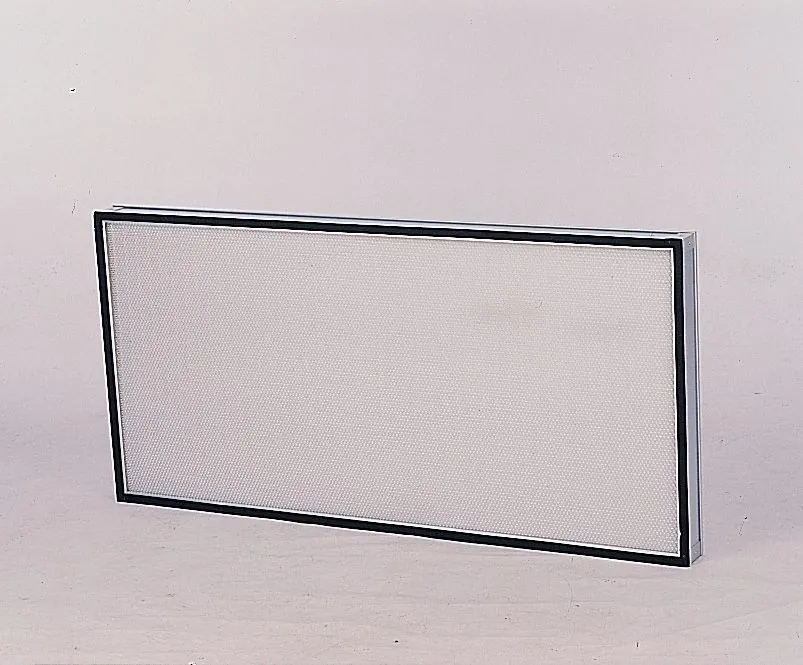
Low-profile filtration for critical clean environments.
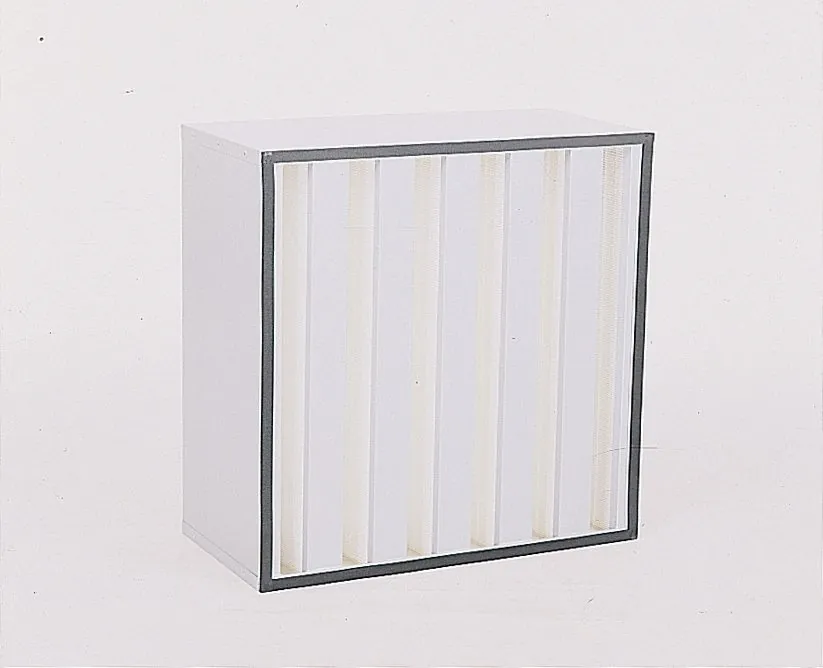
High-area filtration in a compact V-bank format.
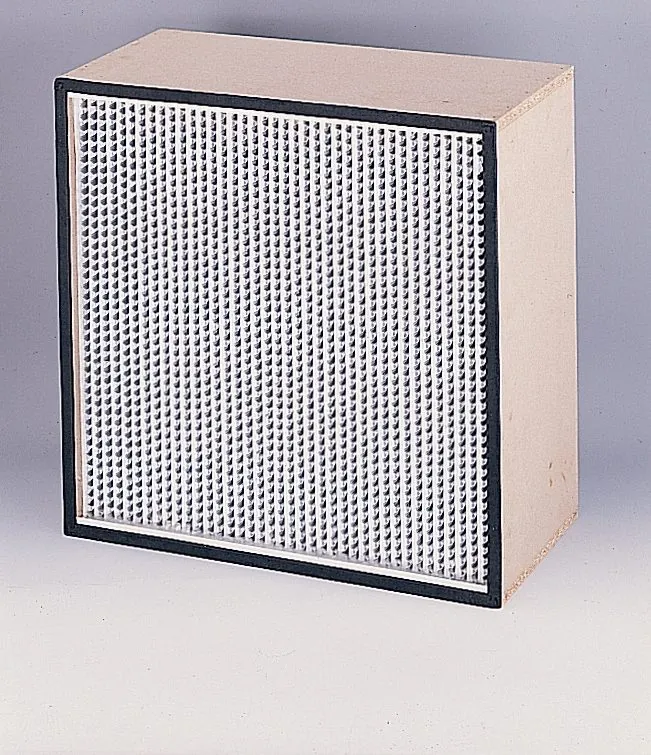
Deep-pleat filtration with corrugated separators.
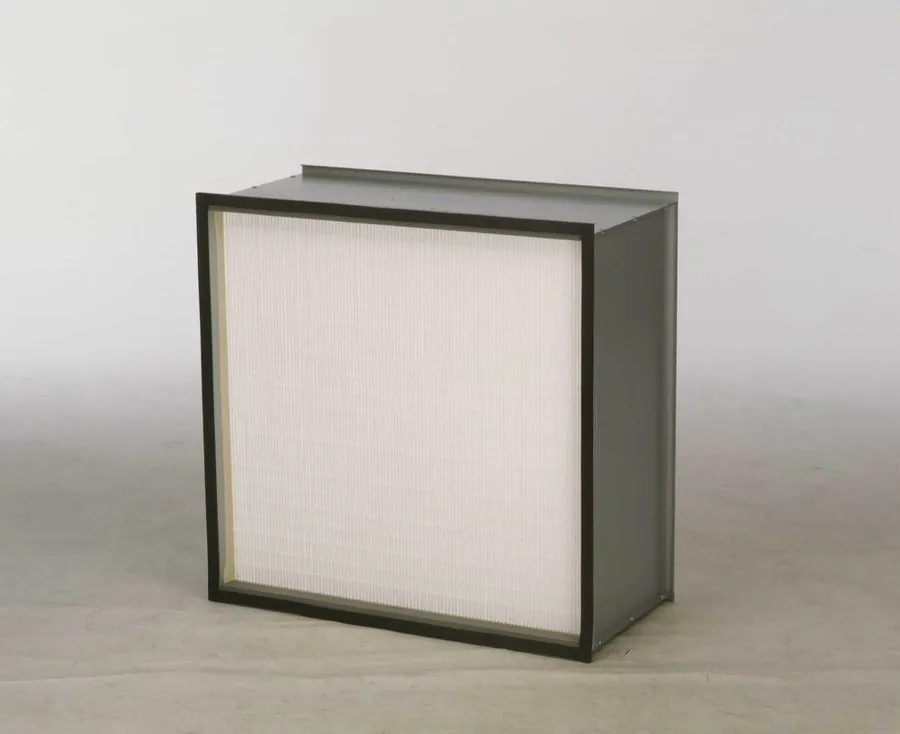
Continuous mini-pleat media for final-stage filtration.