 YIDINGAIR FILTRATION
Get a quote↗
YIDINGAIR FILTRATION
Technical Guides
2026-11-04
How AR504 encapsulated carbon media works, why the target gas determines the media choice, and how to assess airflow, pressure drop, breakthrough and replacement for gas-phase filtration.
Key points
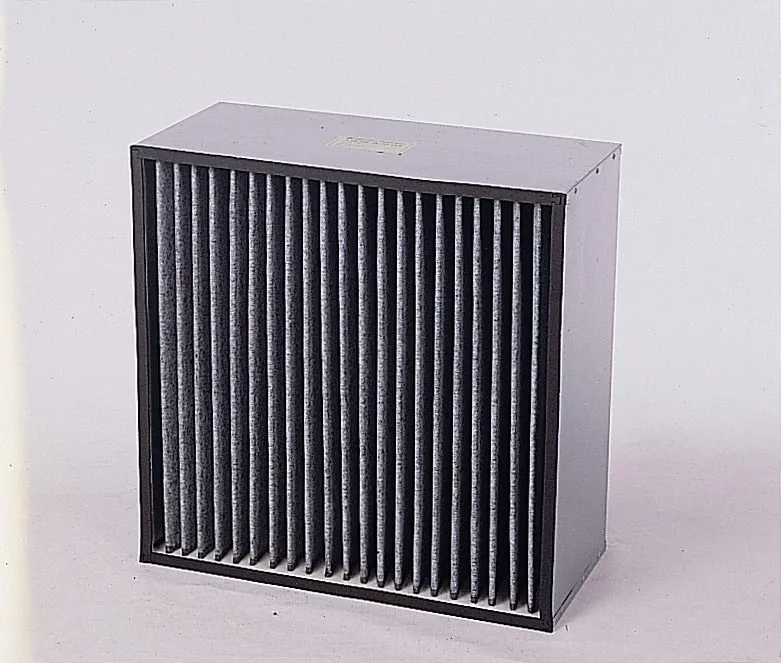
AR504 is Yiding’s encapsulated activated-carbon filter for gas-phase treatment in air handling and sensitive-process applications. The catalogue describes carbon granules held within nonwoven fabric. Encapsulation aims to retain the granules and limit particle shedding; it is not a guarantee of zero emissions or a cleanroom certification. Confirm the complete assembly, seals and any downstream particle-control requirements. [1]
Activated carbon provides internal surfaces on which suitable gas molecules can adsorb. This is different from the capture of dust by a particulate filter. A HEPA or MERV classification does not establish gas-removal performance, and a carbon filter does not automatically replace a HEPA stage. Some pollutants require chemically treated or different sorbents rather than untreated carbon. The selected medium must match the compound and operating conditions. [2]
For sensitive processes, describe airborne molecular contamination (AMC) by chemical species and concentration, not simply as “odour” or “VOCs.” A total-VOC reading may not reveal which component controls media selection.
The Yiding catalogue associates 853 (2750) with VOCs and selected outdoor contaminants such as SO₂, NO₂, ozone and H₂S; 875 (2751) with acidic contaminants; and 147 (2752) with ammonia and amines. These are catalogue identifiers, not universal efficiency classes or evidence that one medium removes all gases. Confirm the actual formulation and a species-specific performance basis. [1]
For acids, including any sulfuric-acid requirement, clarify whether the contaminant is a gas, vapour or aerosol. Acid mist may require a separate particle or droplet-control stage. Do not select a mixed-gas arrangement simply by stacking grades without checking compatibility and test data.
The table below reproduces the published catalogue values, not independently measured results. Dimensions are actual outside dimensions in mm; nominal inch sizes should not be used as installation measurements. Initial pressure drop applies to the paired airflow and configuration. The unusual 1425 m³/h entry is retained as published rather than silently changed; confirm that configuration before ordering. [1]
Do not infer that every deeper filter has lower resistance or longer life from these rows. Media loading, geometry, active volume and operating airflow also matter. Cabinet depth divided by face velocity is not the actual contact time through the active sorbent. Request the pressure-drop curve and configuration details when comparing alternatives.
| Actual size (mm) | Catalogue airflow (m³/h) | Initial Δp (Pa) |
|---|---|---|
| 289 × 595 × 150 | 1700 | 100 |
| 495 × 595 × 150 | 1425 | 100 |
| 595 × 595 × 150 | 3400 | 100 |
| 289 × 595 × 292 | 1700 | 87 |
| 495 × 595 × 292 | 2850 | 87 |
| 595 × 595 × 292 | 3400 | 87 |
Catalogue reference only. Confirm media grade, test conditions and the ordered configuration. Gas-removal efficiency is not stated as a universal percentage.
At a specified time and under matched sampling conditions, removal efficiency can be expressed as η = (Cin − Cout) / Cin × 100%, with Cin greater than zero and both concentrations on the same basis. This describes that measurement, not lifetime performance. Adsorption capacity describes the contaminant mass retained under defined conditions; it is not the same as initial efficiency.
Breakthrough occurs when outlet concentration reaches an agreed limit while the medium may still have remaining total capacity. Temperature, moisture, inlet loading, airflow and gas mixtures affect performance. Pressure drop can remain acceptable while gas removal declines, so differential pressure alone cannot determine the remaining adsorption capacity. [3]
ISO 10121-1 addresses gas-phase media testing; ISO 10121-2 addresses complete gas-cleaning devices for general ventilation. Media results should not be presented as results for an assembled AR504 filter. Referencing a standard is not a claim that AR504 is certified to it. Specify the edition and scope in the agreed test plan. [4, 5]
Ask for the challenge gas and mixture, inlet concentration and units, temperature, relative humidity, airflow, initial efficiency, breakthrough criterion, test duration and capacity basis. A laboratory result for one gas at one concentration is not a universal removal guarantee. For process-critical use, agree downstream acceptance limits and an appropriate sampling method.
Inspect the frame, media containment and seals; prevent bypass and protect the gas stage from unsuitable particle or liquid loading. Record the installed media grade, batch, date, airflow and baseline pressure drop. Choose particle prefiltration and any downstream stage to suit the system.
Plan replacement using the agreed outlet concentration limit, inspections and documented service conditions, supported by suitable monitoring or media assessment. Do not rely on smell alone. Do not wash, bake or regenerate the assembled filter unless a written procedure specifically covers it. Handle spent media according to what it has captured and applicable site disposal requirements. General-ventilation filtration is not a substitute for source control or engineered hazardous-gas protection.
Send target gas species, normal and peak concentrations with units, required outlet limits, airflow, temperature and humidity range, dimensions, available pressure, quantity and installation details. Include requirements for frame, seals, media retention and test documentation. Yiding can discuss custom dimensions, frame materials and media configurations against these needs.
This guide separates general principles from manufacturer catalogue references. It does not promise universal gas removal, a fixed service life, health protection or third-party certification. The approved specification and application-specific evidence define the supplied performance.
No. VOCs are a diverse group. Select and verify the medium for the specific compounds, mixture and operating conditions.
Do not assume so. They may require different media and a reviewed arrangement with gas-specific evidence.
No. Airflow resistance does not measure remaining adsorption capacity. Use the agreed gas-performance criteria.
There is no universal interval. Use actual loading and operating conditions, monitoring and the agreed outlet or breakthrough limit.
No such certification is asserted here. Request the applicable test report and verify its configuration, method and scope.